
Title Transfer in Kenya: What You Need to Know
Title Transfer in Kenya: What You Need to Know
Buying or selling property in Kenya is one of the most significant investments you can make—but the deal is never truly complete until the title transfer is properly executed. A title transfer in Kenya is the legal process of changing the ownership of land or property from one person or entity to another, ensuring the new owner’s rights are recognized by the Ministry of Lands and Physical Planning.
This process might seem complex, but understanding each step can save you time, money, and legal disputes. Whether you’re a homebuyer, investor, or developer, this comprehensive guide explains how to transfer a title deed in Kenya, the requirements, costs, procedures, and common pitfalls to avoid.
🏠 What is a Title Transfer in Kenya?
A title transfer (also referred to as land ownership transfer or property registration) is the process through which legal ownership of a property is officially moved from the seller (transferor) to the buyer (transferee). It involves verifying ownership, paying applicable fees, obtaining approvals, and registering the transaction at the Lands Registry.
Once completed, a new title deed is issued under the buyer’s name—providing proof of legal ownership and protection against future claims or disputes.
📋 Common Reasons for Title Transfers
Title transfer applies to several real estate transactions, including:
-
Sale or Purchase of Property: When land or houses change hands through a sale.
-
Inheritance or Succession: Transfer to beneficiaries following the death of an owner.
-
Gift or Donation: Transfer of land ownership as a gift to relatives or organizations.
-
Corporate or Joint Ownership Changes: Transferring property from individuals to companies or vice versa.
-
Subdivision or Amalgamation: When parcels of land are split or combined, new titles must be issued.
📑 Requirements for Title Transfer in Kenya
To initiate the process, both the buyer and seller must provide essential documents. Ensuring these are complete and accurate helps prevent delays at the Lands Registry.
Seller’s (Transferor’s) Documents
-
Original Title Deed
-
Copy of National ID and KRA PIN
-
Passport-sized photos
-
Land Rent Clearance Certificate (for leasehold land)
-
Rates Clearance Certificate (for properties within counties)
-
Land Control Board (LCB) Consent
-
Signed Sale Agreement between buyer and seller
Buyer’s (Transferee’s) Documents
-
Copy of National ID and KRA PIN
-
Passport-sized photos
-
Duly executed transfer forms (Form L.R. 19 or Form RL 7)
-
Stamp duty payment receipts
-
Valuation report (from the government valuer)
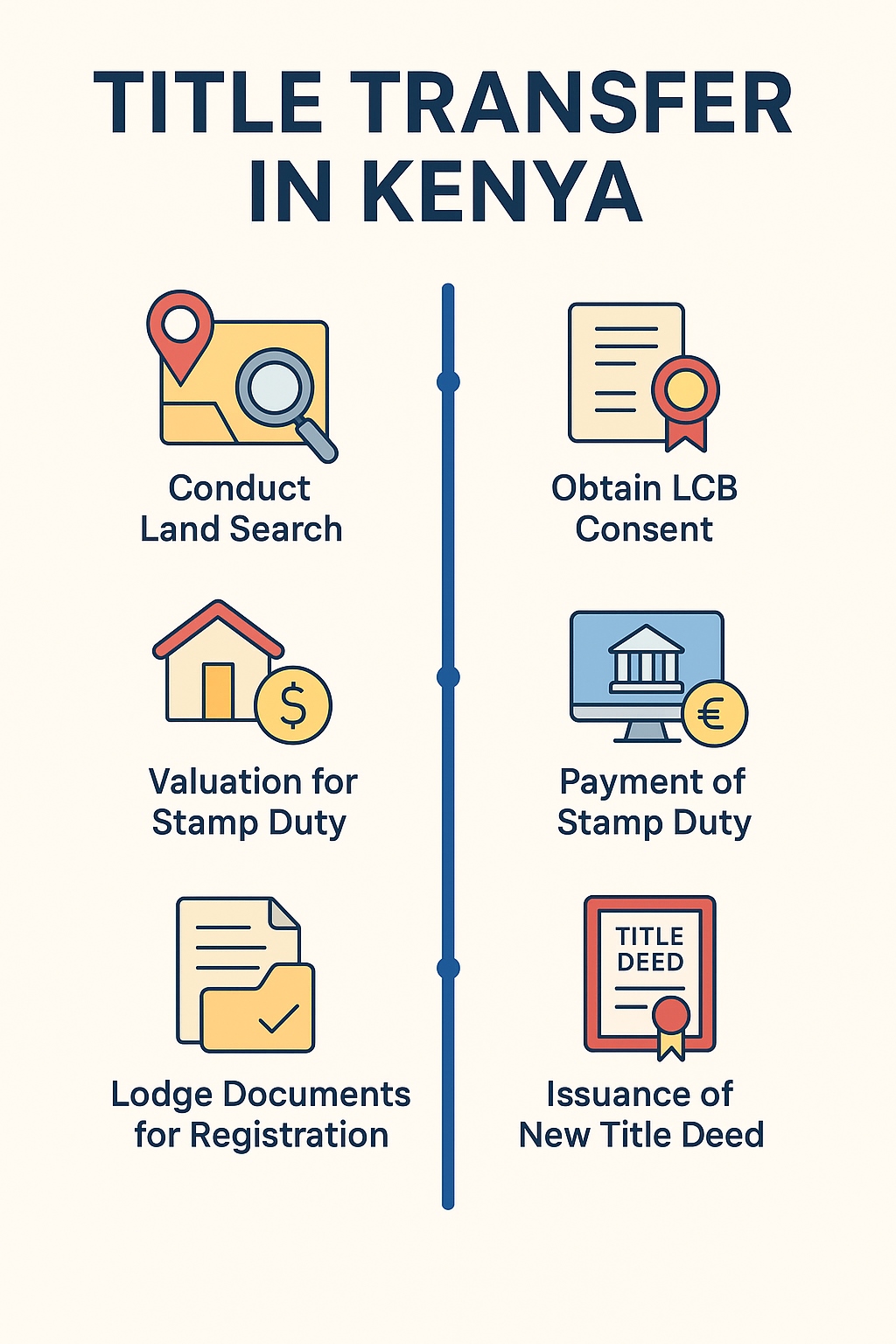
⚙️ Step-by-Step Title Transfer Process in Kenya
Here’s the official procedure for transferring a title deed in Kenya, whether for a residential, commercial, or agricultural property:
Step 1: Conduct an Official Land Search
Start by performing an official search at the Ministry of Lands through the Ardhisasa platform or the local Lands Registry. This confirms:
-
Current registered owner
-
Property size and location
-
Any encumbrances, charges, or caveats
-
Authenticity of the title deed
Step 2: Obtain Land Control Board (LCB) Consent
For agricultural land, the Land Control Board must approve the transaction. Applications can be made at the County Land Control Board offices, and consent is usually issued within 30 days.
There are two types:
-
Ordinary LCB (meets monthly)
-
Special LCB (meets on request; slightly higher fee)
Failure to obtain LCB consent can render the transaction null and void under the Land Control Act (Cap 302).
Step 3: Valuation for Stamp Duty
A government valuer inspects the property to determine its market value, which forms the basis for stamp duty calculation.
The applicable rates are:
-
Urban Areas: 4% of the property’s value
-
Rural Areas: 2% of the property’s value
The valuer issues a Valuation Report used for stamp duty assessment by the Kenya Revenue Authority (KRA).
Step 4: Payment of Stamp Duty
Once valuation is approved, the buyer pays stamp duty via the KRA iTax system or eCitizen portal. Ensure to obtain the official payment receipt and acknowledgment for lodging purposes.
Step 5: Preparation and Lodgment of Transfer Documents
The conveyancing advocate prepares the transfer instruments, including:
-
Transfer form (duly signed by both parties)
-
Consent to transfer
-
Valuation and stamp duty receipts
-
Land rent and rates clearance certificates
-
PIN certificates and IDs
-
Original title deed
All these documents are submitted to the Lands Registry for verification and registration.
Step 6: Registration and Issuance of a New Title Deed
After successful verification, the Registrar of Lands updates the records and issues a new title deed bearing the buyer’s name.
This officially confirms ownership transfer under Kenyan property law.
The original title is canceled and filed at the registry for record-keeping.
💰 Cost of Title Transfer in Kenya
| Cost Item | Estimated Amount / Rate |
|---|---|
| Stamp Duty | 2% (rural) or 4% (urban) of property value |
| Land Control Board Consent | KShs 1,000 |
| Registration Fee | KShs 500 – 1,000 |
| Valuation Fee | Based on government scale) |
| Land Rent Clearance | Variable depending on plot size and tenure |
| Legal/Conveyancing Fees | Based on Lawyers’ scale of fees |
Tip: Always engage a registered valuer or conveyancing lawyer to confirm actual payable amounts and ensure compliance with the Stamp Duty Act and Land Registration Act.
⏱️ How Long Does Title Transfer Take in Kenya?
The average timeline for a complete title transfer is 30 to 90 days, depending on:
-
Accuracy and completeness of submitted documents
-
Speed of valuation and LCB consent approval
-
Lands Registry workload and county clearance procedures
Digital systems like the ArdhiSasa platform have improved turnaround times in Nairobi and select counties, though manual processes are still common in many regions.
⚖️ Legal Framework Governing Title Transfer
Title transfers in Kenya are governed by key property laws, including:
-
Land Registration Act, 2012
-
Land Act, 2012
-
Stamp Duty Act (Cap 480)
-
Land Control Act (Cap 302)
-
Physical and Land Use Planning Act, 2019
Understanding these acts ensures compliance and helps prevent disputes or nullification of transactions.
⚠️ Common Challenges in the Title Transfer Process
-
Fake Title Deeds and Fraudulent Sellers – Always verify ownership through an official search.
-
Unpaid Land Rates or Rent – Outstanding fees can delay transfer approval.
-
Missing Consent or Documents – Failure to provide LCB consent or clearances makes transfer invalid.
-
Slow Registry Processing – Work with professionals to track and expedite the process.
-
Disputed Boundaries – Always confirm survey details and beacon placements.
💡 Tips for a Smooth Title Transfer Process
-
Conduct a due diligence search before making any payments.
-
Ensure all rates, rent, and taxes are cleared.
-
Work with registered valuers and conveyancing advocates.
-
Avoid shortcuts or unofficial payments.
-
Keep copies of all receipts, approvals, and correspondences.
🧭 Why Professional Assistance is Crucial
A professional real estate valuer or conveyancing lawyer helps you:
-
Accurately determine property value for stamp duty purposes.
-
Prepare and review all legal documentation.
-
Verify ownership and property encumbrances.
-
Obtain consents, clearances, and registry approvals efficiently.
This not only ensures legal compliance but also protects you from fraudulent transactions and future disputes.
A title transfer in Kenya is more than a paperwork exercise—it’s the foundation of your legal ownership. Whether you’re acquiring land in Nairobi, Mombasa, Kisumu, or anywhere in the country, following the correct process protects your investment and gives you peace of mind.
By observing due diligence, obtaining the necessary consents, and involving licensed professionals, you ensure that your property transfer is smooth, transparent, and legally binding.
Looking to buy, sell, or transfer property in Kenya? Avenue Property Centre offers professional guidance on title transfer, valuation, land verification, and property investment advisory.
Contact us today to speak with our real estate experts and ensure your next property move is safe, legal, and rewarding.