by admin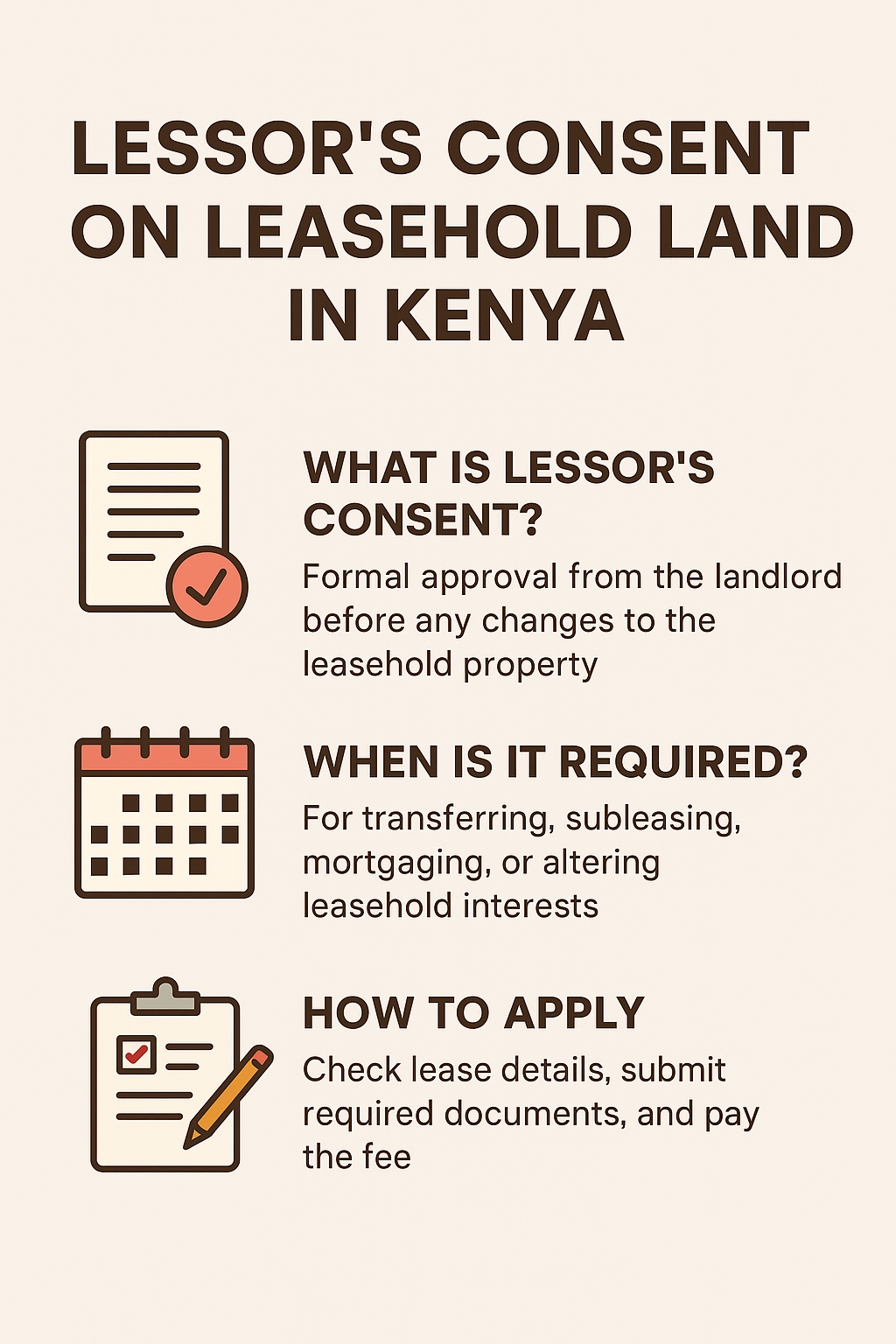
Lessor’s Consent on Leasehold Land in Kenya — Complete Guide
When dealing with leasehold land in Kenya, one of the most important legal requirements is obtaining Lessor’s Consent before transferring, charging, subdividing, or altering interests in the property. This consent is separate from, and often confused with, Land Control Board (LCB) Consent, but the two are completely different.
This guide explains what Lessor’s Consent is, why it is required, when you need it, the process, fees, and implications for buyers and sellers.
What Is Lessor’s Consent?
Lessor’s Consent is the formal approval granted by the landlord (the lessor) before making any changes affecting a leasehold title.
In Kenya, the lessor is often the government (national or county government), but it can also be:
-
A private individual
-
A company
-
A trust
-
A cooperative
-
A church or institution
-
A developer who owns the head lease
The requirement for consent is written directly into the lease agreement or title conditions.
If the lease says no transfer, sublease, mortgage, or major alteration may happen without consent, the transaction cannot proceed until consent is issued.
Why Lessor’s Consent Is Required
The lessor retains underlying ownership (the reversionary interest) and therefore has legal and administrative rights over how the leasehold property is used or transferred.
Consent ensures that:
-
The lessee complies with lease conditions
-
The property use matches zoning and development rules
-
Any outstanding rent or penalties are settled
-
The lessor maintains control over land administration
-
The incoming owner meets eligibility requirements
Without consent, the transaction may be rejected at the land registry.
When Do You Need Lessor’s Consent?
Lessor’s Consent is required for most dealings involving leasehold land, including:
1. Transfer of leasehold property
-
Selling a leasehold house
-
Selling an apartment with a head lease
-
Assigning remaining years to a buyer
2. Subleasing the property
3. Charging/Mortgaging the property
Banks will not register a charge without the lessor’s consent.
4. Subdividing leasehold land
5. Changing the use of the property
Most leases restrict land use (e.g., “residential only,” “commercial only”).
6. Extending or renewing the lease term
7. Adding a co-owner or removing one
8. Altering structures (if controlled by the lease)
Types of Lessors in Kenya and How Consent Works
1. Government (National Government)
-
Common for 99-year or 33-year leases
-
Consent is obtained through the Ministry of Lands
2. County Governments
Especially for properties in:
-
Nairobi
-
Mombasa
-
Nakuru
-
Kisumu
-
Eldoret
-
Machakos
Fees vary by county.
3. Private Lessors
-
Developers (e.g., estate developers)
-
Companies
-
Churches/institutions
Consent terms depend entirely on the lease agreement.
How to Apply for Lessor’s Consent (Step-by-Step)
Step 1: Confirm the lessor
Check your title deed or lease document to identify the correct lessor.
Step 2: Prepare required documents
These commonly include:
-
Application form or written request
-
Copy of title/lease
-
Copy of ID & KRA PIN
-
Signed sale agreement (for transfers)
-
Official search
-
Rent clearance certificate
-
Rates clearance certificate (county)
-
Passport photos (if required)
Step 3: Pay the Lessor’s Consent fee
Fees vary:
-
Government: usually KSh 1,000 – 5,000
-
County governments: usually KSh 5,000 – 20,000
-
Private lessors: range depends on contract, often KSh 10,000 – 100,000+
Step 4: Verification and approval
The lessor reviews:
-
Land rent status
-
Compliance with lease terms
-
Buyer/seller documentation
Step 5: Issuance of Lessor’s Consent
You receive a stamped consent letter allowing the transaction to move forward.
Step 6: Register the transaction at the Land Registry
Without consent, registrars will refuse to complete registration.
Difference Between Lessor’s Consent and Land Control Board Consent
| Aspect | Lessor’s Consent | Land Control Board Consent |
|---|---|---|
| Applies to | Leasehold land | Agricultural land |
| Issued by | Lessor (govt, county, private) | Land Control Board |
| Required for | Transfer, charge, sublease, subdivision | Controlled transactions on agricultural land |
| Based on | Lease agreement | Land Control Act |
| Mandatory? | Yes for leasehold | Yes for agricultural land |
Some transactions may require BOTH consents if the land is agricultural and leasehold.
Penalties and Risks of Not Obtaining Lessor’s Consent
If you transact without consent:
-
The Land Registry will reject the transfer/charge/sublease
-
The transaction is invalid
-
You may lose money paid during the transaction
-
You may incur penalties for breach of lease conditions
-
Banks will not release financing
-
You may face legal disputes or cancellation of the lease
How Long Does Lessor’s Consent Take?
Typically:
-
Government lessor: 2–8 weeks
-
County governments: 1–6 weeks
-
Private lessors: 3–30 days
Timelines depend on document completeness and lessor workload.