by admin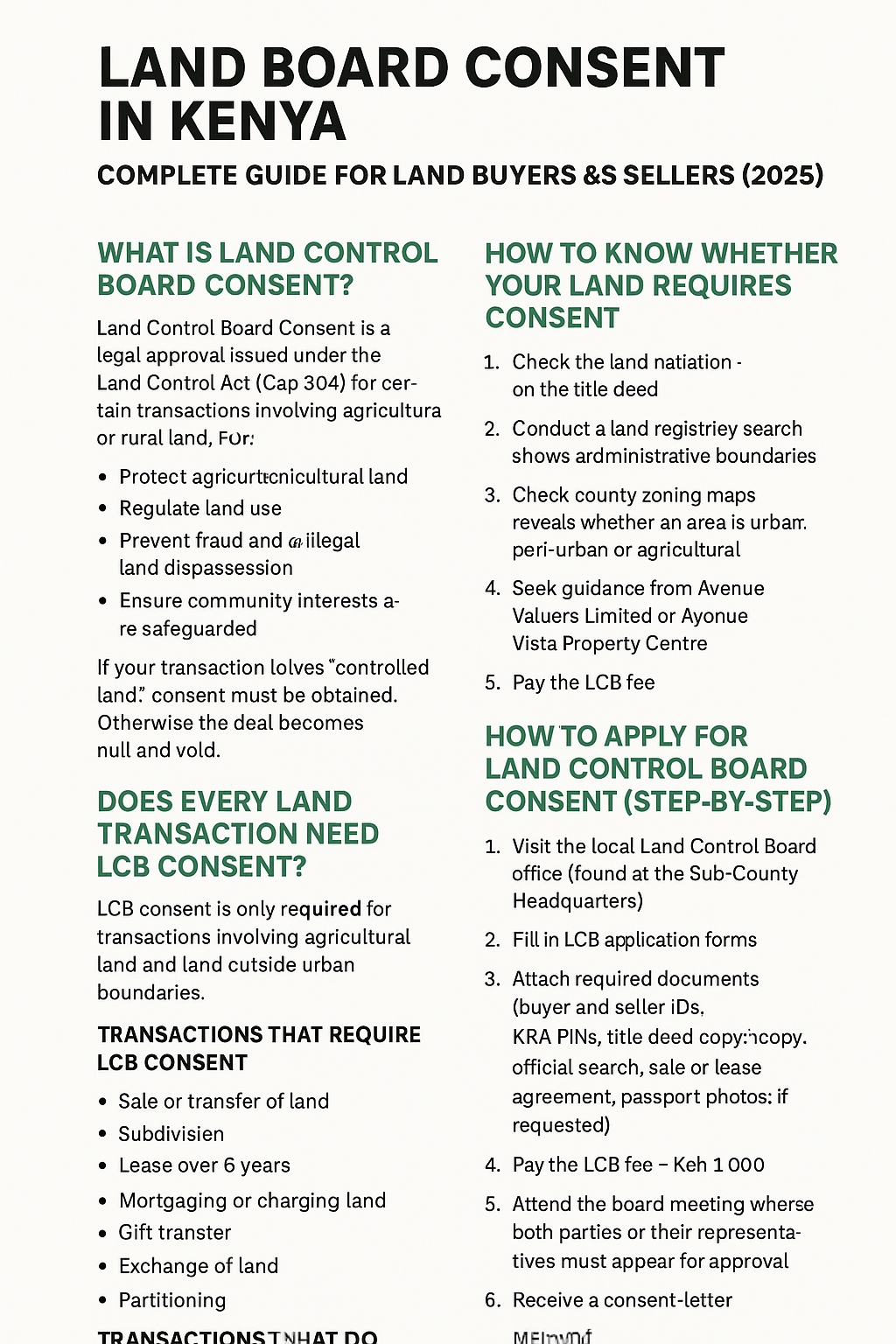
Land Board Consent in Kenya: Comprehensive Guide for Land Buyers and Sellers
Land transactions in Kenya must follow established legal procedures to ensure secure ownership, protect buyers and sellers, and maintain orderly land administration. One of the most important but often misunderstood legal requirements is Land Control Board (LCB) Consent. This guide provides a detailed and SEO-optimized explanation of what Land Board Consent is, when it is required, when it is not required, and how buyers and sellers can navigate the process successfully.
This information is especially useful for property buyers, land sellers, real estate investors, developers, agents, conveyancing lawyers, and valuation professionals across Kenya.
Understanding Land Control Board Consent in Kenya
Land Control Board Consent is a legal approval issued under the Land Control Act (Cap 302) of Kenya. It is required for specific land dealings involving agricultural or rural land. The purpose of this approval is to regulate the use, transfer, and subdivision of agricultural land, protect the economic interests of communities, and prevent unregulated conversions or unlawful dispossession.
The LCB reviews the details of a land transaction to confirm legitimacy, ensure legal compliance, and protect public interests. Without this consent, certain types of transactions are considered null and void under Kenyan law.
When Land Control Board Consent Is Required
Land Board Consent is mandatory for what the law defines as controlled transactions. These controlled transactions involve agricultural land or rural land outside gazetted cities, towns, and municipalities. Any of the following dealings require LCB consent:
1. Sale or Transfer of Agricultural Land
Any sale, transfer, or conveyance of agricultural land must be approved by the LCB prior to registration at the land registry.
2. Subdivision of Land
Breaking down a single parcel of agricultural land into several smaller plots requires approval to ensure the subdivision aligns with planning and zoning policies.
3. Long-Term Leases Exceeding Six Years
Leases of agricultural land for more than six years, whether for residential, commercial, or farming purposes, require LCB approval.
4. Mortgaging or Charging Agricultural Land
When agricultural land is used as security for a loan or financial obligation, LCB consent is necessary.
5. Partitioning of Agricultural Land
Partitioning among co-owners or beneficiaries requires LCB approval to ensure legality and fairness.
6. Gift Transfers and Exchanges
Gifting agricultural land or exchanging land parcels are also controlled transactions and require consent.
7. Sale of Shares in Companies Owning Agricultural Land
If a company owns agricultural land, disposal or transfer of shares affecting more than a certain percentage may require consent.
Transactions That Do Not Require Land Board Consent
Not all land transactions in Kenya require LCB approval. The following categories of land or areas are exempt:
1. Land Within Cities, Municipalities, and Townships
Any land located within gazetted urban areas does not require Land Board Consent. Urban plots in Nairobi, Mombasa, Kisumu, Nakuru, Thika, Eldoret, and other towns fall into this category.
2. Land Classified as Non-Agricultural
If the land is legally designated as commercial, residential, industrial, or mixed-use within an urban planning framework, LCB consent does not apply.
3. Land Owned by Certain Public Bodies
Specific government institutions and public bodies may be exempt depending on statutory provisions.
4. Short-Term Leases of Under Six Years
Leases shorter than six years do not require LCB approval, regardless of land classification.
Understanding whether the land falls within an urban or agricultural classification is essential to avoid delays and legal disputes.
How to Confirm Whether Land Requires LCB Consent
Before proceeding with any land sale or purchase, the following checks are crucial:
1. Review the Title Deed
The title may indicate the land’s classification, such as agricultural, commercial, or residential.
2. Conduct an Official Land Search
A land search provides information on location, tenure, restrictions, and the administrative area in which the parcel falls.
3. Check County Zoning Maps
County governments maintain zoning maps that show whether an area is categorized as urban, peri-urban, or agricultural.
4. Consult a Registered Valuer or Real Estate Professional
Experts such as Avenue Valuers Limited or Avenue Vista Property Centre can help verify land classification and guide you through compliance requirements.
Step-by-Step Procedure for Obtaining Land Control Board Consent
The process of obtaining LCB approval is straightforward when conducted correctly. The general steps include:
Step 1: Visit the Local Land Control Board Office
The LCB office is usually located at the Sub-County or District Headquarters in the area where the land is situated.
Step 2: Complete the Required Application Forms
Forms are provided at the LCB office. The specific form used depends on the nature of the transaction.
Step 3: Prepare the Necessary Documents
Documents typically required include:
-
Copies of National ID cards for both buyer and seller
-
KRA PIN certificates
-
Copy of the title deed
-
Current official search
-
Sale agreement or relevant contract
-
Passport photos (if required)
-
Any additional supporting documents requested by the LCB
Step 4: Pay the Official Application Fee
The standard fee for Land Board Consent is Ksh 1,000, although specific counties may have slight variations.
Step 5: Attend the Scheduled LCB Meeting
Both parties must appear in person or be represented legally. The board may ask questions to confirm the authenticity and fairness of the transaction.
Step 6: Receive the Land Board Consent Letter
If the application is approved, a consent letter is issued. This letter must be presented to the land registry for transfer, lease registration, subdivision approval, or charge registration.
Processing Time for Land Board Consent
Land Control Boards often convene once every month. In high-demand areas, meetings may occur twice a month.
On average, the LCB process takes two to four weeks depending on meeting schedules and the completeness of documentation.
Legal Importance of LCB Consent
LCB consent carries significant legal weight. Transactions that require consent but are completed without it are automatically considered invalid. The Land Control Act clearly states that any controlled transaction conducted without LCB consent is null and void for all legal purposes.
Consequences of Failing to Obtain Consent
-
The land transfer cannot be registered at the land registry
-
The buyer does not acquire legal ownership
-
The seller must refund all money received
-
Courts rarely enforce agreements lacking consent
-
Serious disputes may arise between parties
This is why compliance with LCB requirements is essential for both buyers and sellers.
Benefits of Obtaining Land Board Consent
For Buyers
-
Ensures the land transaction is legal
-
Confirms the seller has full rights to transfer the land
-
Protects against fraudulent or disputed land sales
-
Safeguards long-term investment
For Sellers
-
Protects the seller from future ownership disputes
-
Ensures the buyer is recognized legally
-
Enhances transparency and trust
-
Facilitates a smooth registration process
Role of Valuers, Real Estate Agents, and Property Consultants
Professional assistance is important when dealing with land issues. Registered valuation firms and real estate agencies can assist with:
-
Conducting land searches
-
Determining land classification
-
Preparing LCB documentation
-
Advising on legal requirements
-
Facilitating meetings and approvals
-
Ensuring compliance with land laws
Highly experienced firms specialize in guiding clients through the entire process, ensuring smooth and legally compliant land transactions.
Practical Tips for Land Buyers and Sellers in Kenya
-
Always verify land classification before signing any agreement
-
Conduct a comprehensive land search
-
Avoid making large payments before confirming LCB requirements
-
Keep copies of all forms, receipts, and approvals
-
Work with skilled real estate agents or valuers to avoid delays
-
Attend LCB meetings promptly to prevent missed approvals
-
Ensure both parties have accurate identification and PIN documents
Proper preparation significantly reduces the risks associated with rural and agricultural land transactions.
Do You Need Land Board Consent?
The need for LCB consent depends entirely on the classification and location of the land.
If the land is rural or agricultural, Land Board Consent is mandatory.
If the land lies within a city, municipality, or township, consent is not required unless stated otherwise by law.
Understanding these distinctions ensures that land buyers and sellers remain compliant, avoid unnecessary delays, and protect their investments. Consulting professionals makes the process easier, safer, and more reliable.
FAQs on Land Control Board Consent in Kenya
1. How long does it take to schedule a Land Control Board meeting?
Most sub-county boards meet once a month, but schedules vary. Some high-demand areas may require early booking because slots fill up quickly. Buyers and sellers should plan their timelines around the board’s monthly calendar to avoid delays.
2. Can you apply for Land Control Board Consent online?
A few counties have experimented with partial digital workflows, but approval still generally requires physical attendance or representation. Always confirm with the respective sub-county office to know whether digital submission is accepted.
3. Can someone attend the Land Control Board meeting on your behalf?
Yes. A party may be represented through a power of attorney. The POA must be legally registered, and the representative must carry original identification documents for both parties.
4. What happens if the Land Control Board declines my application?
If declined, you may appeal the decision to the Central Land Control Appeals Board. This appeal must be submitted within the legally prescribed timeframe. A well-documented justification and supporting documents usually strengthen the appeal.
5. Does Land Control Board Consent affect inheritance of agricultural land?
Inheritance technically transfers ownership through succession law, not a controlled transaction. However, if the successor later intends to sell, subdivide, charge, or lease the inherited agricultural land, consent will then be required at that stage.
6. Are there transactions involving agricultural land that are exempt from LCB consent?
Yes. Transfers involving government bodies, statutory institutions, or land conversions authorized through national government directives may be exempt. In such cases, other regulatory pathways substitute LCB consent.
7. Can an agricultural property be converted to non-agricultural use to avoid LCB requirements?
Yes, but only through a formal land-use change application under county physical planning laws. Once reclassified and approved through the proper channels, the property becomes subject to urban planning rules rather than LCB oversight.
8. Does LCB consent apply to properties within newly upgraded municipalities?
Some regions have recently transitioned from rural to urban governance. In these cases, classification depends on whether the area has been officially gazetted as part of a municipality or city. A search or planning confirmation helps avoid confusion.
9. Can banks refuse to process a charge even after LCB consent is issued?
Yes. Banks perform independent due diligence. Even with consent, a lender may decline financing due to valuation issues, title defects, zoning concerns, or borrower risk. LCB consent is only one element of the approval chain.
10. Can a buyer or seller check the authenticity of an issued LCB consent?
Consent letters can be verified at the sub-county land control office. You can confirm the meeting date, board signatures, and minute references. Verification is recommended to avoid fraudulent or altered documents.
11. What should foreign investors know about LCB requirements?
Foreign nationals cannot directly own agricultural land unless exempted by the President. For foreign investors, local partnerships or land-use arrangements may be required. It is crucial to conduct legal due diligence before committing to any transaction.
12. Does LCB consent impact the ability to develop or construct on agricultural land?
Construction approvals fall under the county physical planning department, not the Land Control Board. However, if land is being subdivided or significantly restructured for development, LCB requirements may apply depending on the nature of the transaction.
13. Can LCB consent be processed if the title has encumbrances?
Yes. Consent may be issued, but registration of the transaction may be blocked until encumbrances are lifted.
14. Does valuation affect the LCB application?
The declared consideration is reviewed for authenticity, but LCB does not perform valuation.
15. Does consent apply when gifting agricultural land to a family member?
Yes. Transfers by gift of agricultural land require consent.
16. What happens if a landowner refuses to attend the LCB meeting?
The transaction cannot proceed unless they appoint a representative via a legal POA.
17. Can LCB consent be applied for after paying the full purchase price?
Yes, but buyers are advised to apply earlier to avoid complications if consent is denied.
18. Is consent required for consolidating multiple parcels of agricultural land?
Yes. Consolidation of agricultural land is treated as a controlled transaction.
19. Does consent apply for renewal of an existing long-term lease?
Yes. Renewals creating new lease terms generally require consent.
20. Can you appeal directly to court if LCB refuses to grant consent?
No. You must first appeal to the Land Control Appeals Board before approaching the High Court.
21. Is LCB consent needed to use land as collateral for informal loans?
If a formal charge is registered at the lands registry, consent is required.
22. Can the board conduct site visits before granting consent?
Yes. Some boards conduct site assessments for complex or disputed applications.
23. Is a consent fee refundable if a transaction fails?
Usually, no. Fees are often non-refundable regardless of transaction outcome.
24. What documents strengthen an LCB application?
Accurate sale agreements, title details, identification, land maps, and any planning approvals.
25. Does LCB consent affect stamp duty assessment?
No. Stamp duty is assessed independently by the Kenya Revenue Authority.
26. Is LCB consent needed to transfer land into a trust?
Yes, if the land is agricultural. Trust formation is treated as a controlled transaction.
27. Can LCB consent be granted conditionally?
Yes. Boards may issue conditional approval, requiring certain actions before registration.
28. What happens if the seller dies after consent is issued but before transfer?
The transaction must go through succession before transfer unless it was completed earlier.
29. Does the size of land affect LCB applicability?
No. Both small and large agricultural parcels fall under the same legal framework.
30. Can the Land Control Board decline consent due to disputes among family members?
Yes. Disputes, competing claims, or unclear ownership can cause automatic rejection until resolved.