by admin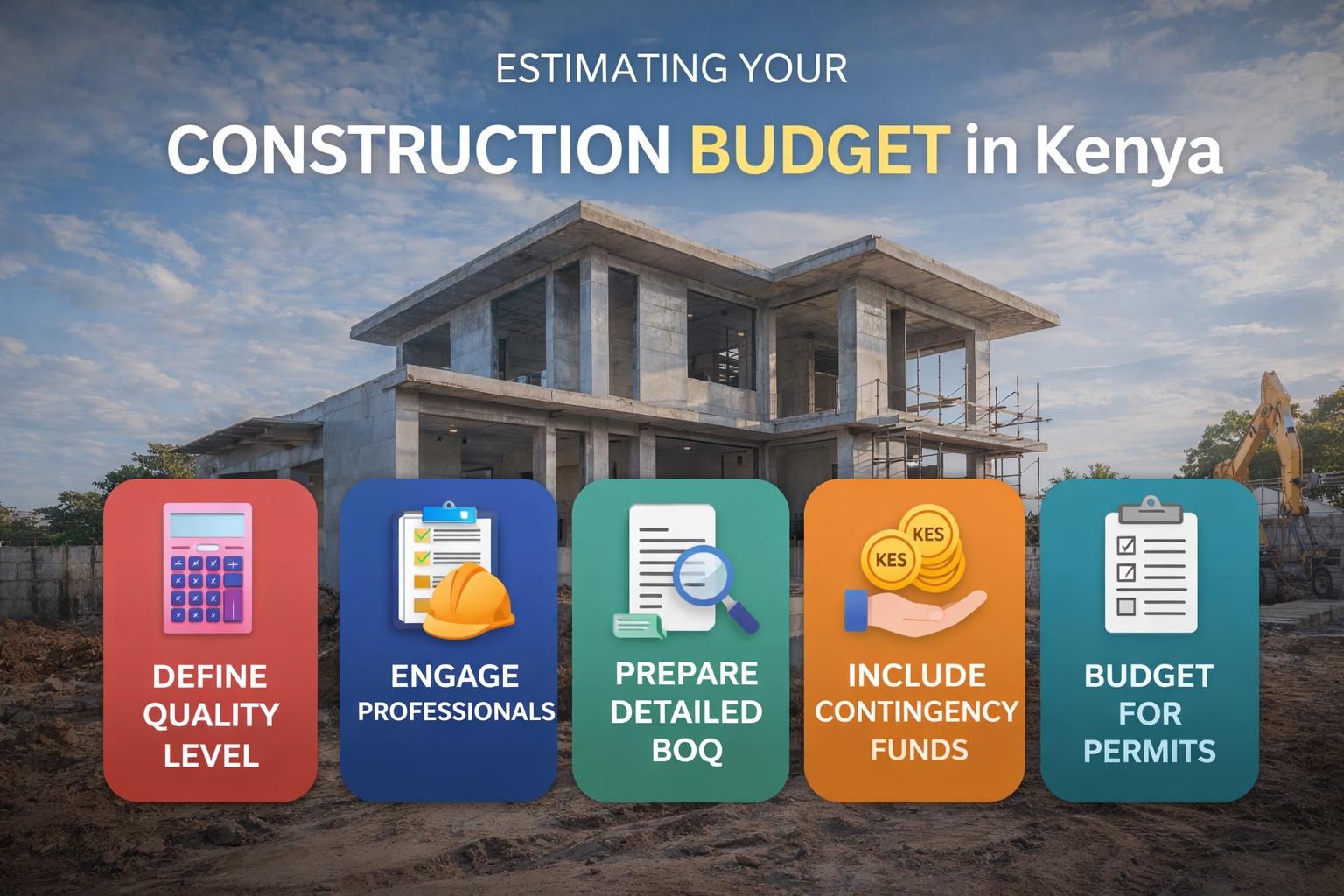
Practical Tips for Estimating Your Construction Budget in Kenya
Building a home, office, or commercial property in Kenya is a significant investment. Whether you’re planning a residential villa in Nairobi’s Karen suburb, a luxury apartment in Mombasa, or a commercial building in Western Kenya, accurate budgeting is crucial.
A well-estimated construction budget not only ensures you stay financially disciplined but also helps you avoid delays, cost overruns, and compromise on quality. In Kenya, construction costs can fluctuate due to material prices, labour availability, location, and regulatory requirements.
This guide provides practical, actionable tips to estimate your construction budget effectively, helping homeowners, investors, and developers make informed decisions.
1. Understand the Total Cost Components
A construction budget goes beyond the physical building costs. The key components include:
-
Land Costs – The price of the plot, legal fees, surveys, and title documentation.
-
Building Construction Costs – Materials, labour, contractor fees, and equipment hire.
-
Professional Fees – Architects, engineers, quantity surveyors, and interior designers.
-
Permit & Regulatory Costs – County approvals, NEMA clearance, and utility connections.
-
Utilities & Landscaping – Electricity, water, sewer connections, paving, gardens, and fencing.
-
Contingency Fund – Typically 10–15% of the total budget for unexpected costs.
Tip: Allocate each component as a percentage of the total budget for clarity and control. For example, professional fees may account for 8–12% of the total cost, while contingency funds should not be underestimated.
2. Define Your Quality Level Early
Construction costs vary greatly depending on the type of finishes and materials:
-
Budget / Economy – Basic finishes, local materials, and minimal automation.
-
Standard / Mid-Range – Durable finishes, modern layouts, and some imported materials.
-
Premium / Luxury – High-end materials, smart home systems, and bespoke designs.
-
Ultra-Luxury / Contemporary – Architectural masterpieces with imported fixtures, advanced technology, and large-scale landscaping.
Tip: Decide your quality tier at the start. Changes during construction can increase costs by 15–25%.
3. Factor Regional Cost Variations
Construction costs in Kenya differ by location:
| Region | Standard Build (KES/m²) | Premium Build (KES/m²) |
|---|---|---|
| Nairobi | 45,000 – 64,000 | 82,000 – 96,000+ |
| Mombasa / Coast | 52,500 – 61,500 | 79,500 – 89,500 |
| Western Kenya | 38,000 – 48,000 | 58,000 – 75,000 |
Insight: Urban centres like Nairobi incur higher labour and material costs, whereas Western Kenya offers more competitive pricing. Coastal constructions may require corrosion-resistant materials, slightly increasing costs.
Tip: Always use regional cost indices when calculating your budget.
4. Engage Professional Help Early
Hiring professionals can save money in the long run:
-
Architects – Design efficient layouts to optimise space and reduce unnecessary costs.
-
Quantity Surveyors – Prepare detailed bills of quantities (BOQs) to prevent overspending.
-
Engineers – Ensure structural safety and compliance.
Professional fees are usually 5–12% of total construction costs depending on the complexity of the project. Skipping professional input can result in costly reworks.
5. Prepare a Detailed Bill of Quantities (BOQ)
A Bill of Quantities (BOQ) is the cornerstone of any construction budget. It lists every material, item, and service required, along with quantities and estimated costs.
Benefits of a BOQ:
-
Enables accurate contractor quotations
-
Helps track expenditure during construction
-
Reduces risk of budget overruns
Tip: Always get a quantity surveyor to prepare or validate your BOQ. This ensures costs reflect market rates for materials and labour.
6. Account for Labour Costs
Labour is a major component of construction costs in Kenya, typically 25–35% of the total budget. Rates vary by skill:
-
Skilled labour (masons, carpenters, electricians, plumbers) – higher rates, often in Nairobi and Mombasa.
-
Unskilled labour – more affordable, but limited to non-specialist tasks.
Tip: Consider hiring a mix of local and skilled labour. Ensure labour contracts are clear to avoid delays and disputes.
7. Include Contingency Funds
Unexpected expenses are common in construction. Factors include:
-
Material price fluctuations
-
Design changes
-
Delays or weather-related issues
-
Equipment breakdowns
Tip: Set aside 10–15% of your total budget as a contingency fund to cover unforeseen costs.
8. Consider Material Sourcing & Logistics
Material costs and availability affect budgets significantly:
-
Locally sourced materials – Cheaper, easier to transport, but sometimes lower quality.
-
Imported materials – High quality, premium finishes, but higher cost and delivery delays.
Tip: Plan logistics carefully and negotiate bulk purchases for materials like cement, steel, and tiles to reduce costs.
9. Factor in Permits and Regulatory Fees
Kenyan counties require several approvals:
-
Building plan approval
-
Environmental Impact Assessment (NEMA)
-
Water and electricity connections
-
Occupation certificates
Fees vary by county and property size. Skipping these approvals can result in fines or legal challenges.
Tip: Include 2–5% of your budget for regulatory compliance.
10. Monitor & Update Your Budget Regularly
Construction budgets are dynamic. Regular monitoring allows you to:
-
Compare actual expenditure vs. planned
-
Adjust for price fluctuations or design changes
-
Maintain financial control and avoid overspending
Tip: Use construction management software or spreadsheets to track costs in real time.
11. Understand Financing Implications
If you’re using a mortgage or construction loan:
-
Banks may release funds in stages, based on project milestones
-
Ensure your budget aligns with the financing schedule
-
Include interest and loan processing fees in the total budget
Tip: Discuss funding and cash flow projections with your financial advisor before starting construction.
12. Sustainable & Energy-Efficient Features
Incorporating green building features can increase upfront costs but reduce long-term operating costs:
-
Solar panels and hybrid energy systems
-
Rainwater harvesting and boreholes
-
LED lighting and energy-efficient HVAC
-
Thermal insulation and double-glazed windows
Tip: Budget 5–10% extra for sustainable features—they improve resale value and attract premium tenants or buyers.
13. Common Mistakes to Avoid
-
Underestimating labour or material costs
-
Not including professional fees or permits
-
Skipping contingency funds
-
Ignoring regional cost differences
-
Failing to monitor budget updates during construction
Avoiding these mistakes is key to staying within budget and on schedule.
Estimating your construction budget in Kenya requires careful planning, professional input, and continuous monitoring. By understanding the full cost components, factoring in regional variations, sourcing materials wisely, including contingency funds, and engaging qualified professionals, you can achieve a well-planned, cost-effective construction project.
Whether building a modern villa in Karen, a smart townhouse in Lavington, or a commercial property in Kisumu, these practical tips help ensure your project stays on budget while achieving quality and design excellence.